kruizing with kikukat

Thursday, July 14, 2011

Kim Chee Burgers

When its baseball season, teams/leagues often have fundraisers, selling everything from cookies to laulau.  One league is known for their kim chee burger fundraisers.  For years, The Help was on the "call list", receiving calls from excited mothers about the upcoming fundraising event.  The Help was infamous for buying a half-dozen of the burgers and polishing them off in a single sitting.  Most normal people can't eat a half-dozen burgers at one time, and most normal people likely don't want to limit consumption of these fantastic gems to baseball season, especially when grilling weather is year-round.

Kim chee burgers are unique in that kim chee, Korean pickled vegetables (nappa cabbage, in this case), represents the vegetable component of a typical burger.  The burger mix is a teriyaki-based conglomeration with sesame oil and ground sesame seeds giving it a Korean twist.   The burger mix is smeared very thinly onto the cut surface of a hamburger bun.  Because smearing the meat can be time-consuming, this is definitely something that can and should be made a few days before they are to be eaten.  The process begins by smearing the  buns with a thin layer of the burger mix.  Contrary to what some may think, the purpose of the thin layer is not to stretch pennies.  But I'm getting there.  The bun halves are frozen in a single layer on a cookie sheet.
When frozen (at least 2 hours), the buns are re-stacked into sets with a piece of parchment paper between meat layers and placed back into the bun bag.  These burgers cook quickly so they can be kept frozen up until 10 minutes before chow time.  When ready to serve, the burgers are cooked by grilling only the meat-side of the bun (hence the thin layer of burger mix).  A generous mound of kim chee is sandwiched between both bun halves before being devoured by hungry monsters.

click on recipe title for printable recipe 
Kim Chee Burgers

     1 lb lean ground beef
     2 tsp sugar
     2 tbsp shoyu
     1 tsp sesame seeds, toasted and ground
     2 tbsp sesame oil
     1 clove garlic, minced
     1" piece ginger, grated
     2 tbsp green onions, minced
     16 hamburger buns

Combine all ingredients except hamburger buns.  Spread about 2 teaspoons of beef mix onto each bun half, spreading all the way to the edges in a very thin, even layer.  Freeze in a single layer.  When frozen, stack with parchment paper between meat layers.  Cook each bun half meat-side down only on a hot grill. Meat should be cooked when bun is no longer cold.  Serve with slices of kim chee between halves.  
    

Monday, July 11, 2011

Frog Eye Salad

I am dedicating this post, Frog Eye Salad, to my amphibious brethren out there . . . those of you who, by sheer bum luck, tend to get caught in slippery situations beyond your control.  If this sounds like you or if you know someone who has webbed feet and can jump many times his/her body length, read on . . .

We are knee-deep in what is likely the soggiest summer in Hilo in the past 15 years.  I counted more days of rain than sun, which supports Hilo's infamy as being the wettest city in the United States.  I am so glad to have retired from league tennis, as I'd likely spend more time squeegee-ing the court than actually playing.  Bejeweled Blitz is a much better pastime!

I've come to the conclusion that I am a magnet for wet places, no matter how much I keep saying I don't like rain.  My four years in Seattle were miserably damp.  I'm likely the only person who has attempted to escape the Hilo rain, only to be drenched by a sudden downpour in the parking lot of the Kona Costco.  In another botched attempt to circumvent rain, I ran off to the Hapuna Prince and was treated to an amazing show that night: thunder, lightning, torrential rain.

acini di pepe
One of the silly traditions of league tennis in Hilo is the camaraderie-building potluck after each match, which often forces one to display acts of sportsmanship long after an opponent has humiliated you on the court.  Having played league tennis on Oahu for several years, I can safely say this practice does NOT happen there.  Lest I sound like an ingrate, it is because of these silly gatherings that I became acquainted with frog eye salad.  Someone on my team brought it as a potluck contribution.  It was absolutely delicious, but inimitable, as there was no market in Hilo which carried the "frog eyes", acini di pepe pasta.
That was way back in the early years of the 21st century, and Hilo today is much different place from what it was 10 years ago.  We have a new Safeway that has an olive bar, and that same Safeway also carries acini di pepe pasta!  Ribbit ribbit. . .


 click on recipe title for printable recipe
Frog Eye Salad

     1 c acini di pepe pasta
     water
     2 cans mandarin oranges
     1 can (20 oz) crushed pineapple
     1 c sugar
     1/2 tsp salt
     2 eggs, well beaten
     3 tbsp flour
     8 oz. Cool Whip, thawed
     4 c miniature marshmallows
     1 c maraschino cherries, drained (optional)
Bring water to a boil and cook acini di pepe pasta for 9 minutes.  Drain.  Drain mandarin oranges and pineapple, reserving 1 1/2 c of juice.  Refrigerate mandarin oranges and pineapple.  In a medium saucepan, combine juice with sugar, salt, eggs, and flour.  Cook, stirring constantly with a whisk, until thick.  Remove from heat.  Add drained pasta to sauce and mix gently.  Place in a large, covered bowl, and refrigerate overnight.  Add drained fruit, Cool Whip, and miniature marshmallows to acini di pepe mixture.  Combine gently and refrigerate until ready to serve.

Thursday, July 7, 2011

Oxtails for Dinner: Khal Bi Style with Udon

I love oxtails!  I love oxtails!  I love oxtails!  Did I say I love oxtails?  When I was young, I'd be thrilled when my dad would order oxtail soup at restaurants.  My favorite part was the peanuts.  They'd be soft after the long cooking and just melt in your mouth.  I was also strangely fascinated by the gelatinous "eyes" on the ends of each oxtail segment.  Soup was much coveted because my parents never made oxtail soup.  Anytime oxtails were purchased, I knew they'd make oxtail stew, which was good, but definitely not at the same "like" level as soup. 

As an adult, I've had the opportunity to order my own oxtail meals in restaurants.  I have a hard time ordering anything else when I see oxtail soup on the specials menu.  A big bummer is when the oxtails haven't been sufficiently cooked.  Few things suck as much as tough oxtails.  In my mind, oxtails are supposed to be falling-off-the-bone soft.  Strangely enough, I've never made oxtail soup.  I'm not sure why, but somehow, a huge pot of oxtail soup that will take me several days to finish just doesn't sit well with me.  Ken's Pancake House in Hilo makes a good soup.  Its a Friday special.

A few years ago, I splurged on the Zuni Cafe cookbook.  Zuni Cafe is a restaurant in San Francisco which is famous for taking a basic dish like roast chicken and turning it into the kat's meow.  The first (and sadly, only) recipe I've tried from the cookbook is Red-Wine Braised Oxtails.  Its very "involved", but the reward is in the taste.  The meat is falling-off-the-bone tender.  After making it several times, I've come up with a few shortcuts so I plan to eventually post my recipe when I get more pictures.

When I went to Costco on Saturday, they had a whole bunch of oxtails.  Impulsively, I bought a pack, thinking I'd freeze them and eventually get around to making the Zuni Cafe-adapted recipe.  But The Help suggested I try to develop a copycat khal bi oxtail, like the one you can buy premade from George's Meat Market.  I groaned because this was not going to be a walk in the park.

Khal Bi Oxtails from George's Meat Market . . .la la la. . . heaven in a bag.  Stacey sure knows her way around oxtails.  Meat is exactly the way its supposed to be . . . silky and falling-off-the-bone.  The flavor is a sesame-laced teriyaki.  Best of all, its cooked so its just a matter of heating it up.

Realizing I had two main issues, the sauce and the cooking, I decided to tackle the sauce first.  George's Khal Bi Oxtails tastes a little bit like shoyu pork with a touch of sesame.  I pored through cookbooks and eventually settled on a sauce based on the recipe for "Ono Pork Butt" from one of the Moanalua High School Project Graduation cookbooks.  The second part, cooking method, came a little quicker since I threw in the towel and decided to just follow the Zuni Cafe recipe's cooking method (braise).

To get maximum flavor, brown all sides of each oxtail piece well.
Use a gravy separator to remove most of the liquid fat from the liquid.
Four hours later, I was very satisfied with my copycat recipe.  Because I had ample sauce (something the George's one lacks) I decided to serve the oxtails with blanched bok choy, thinking that the reduced, concentrated sauce would be nice with greens.  I was a little stumped on the starch, but at 3:30, I chose udon noodles.  Rice was too pedestrian, and saimin/ramen noodles would not be able to hold a strong sauce like this.  Udon noodles were substantial enough to handle the sauce.


If you are not lucky enough to have easy access to George's Meat Market, or if you are like me and want to eat more than two pieces without spending all the hard-earned DOE paycheck, please try my Khal Bi Oxtails.  And if you come up with a better cooking method that will produce meat that melts when you eat it, please share it with the rest of us.
Serve it in a bowl with udon noodles, blanched bok choy, and some liquid.
Here you see that some spicy shredded potato has been added to the bowl.
 click on recipe title for printable recipe
 Khal Bi Oxtails with Udon

     1 large package oxtails (3-4 lbs)
     oil
     garlic, grated
     ginger, grated
     1 c shoyu
     1/2 c mirin
     1 c brown sugar, packed
     1 c water
     1/2 c sake
     blanched bok choy
     udon noodles, cooked as directed on package

In a 5-qt dutch oven, heat oil and brown oxtails on all sides.  Add garlic and ginger to pot.  Place oxtails with "eyes" facing up.  Add shoyu, mirin, brown sugar, water, and sake.  Cover and bake in a 300 degree oven for 2 hours.  Remove cover and bake 30 more minutes.  At this point, oxtails can be refrigerated overnight and hardened fat removed before proceeding, or use a fat separator to remove as much fat as possible.  Preheat oven to 350 degrees.  Bake covered for 15 minutes or 30 minutes (if chilled overnight).  Remove cover and bake 30 minutes more. 


Monday, July 4, 2011

Celebrating with Lobster

Sometimes I just don't feel very American.  Its not that I'm anti-America (truth is, I love being an American), but there are many times that I feel the rest of the United States levies a special penalty against me (and everyone else who lives in the 808).  For example, many retailers in the continental U.S. will not extend free shipping offers to Hawaii addresses.  In fact, many take advantage of the opportunity to gouge us.  This is why I try to limit my online purchases to websites that offer reasonable shipping charges to Hawaii:  Amazon, Origins, Crocs, PT's Coffee, Petco, Arcata Pets, Apple, Verizon, just to name a few.  There have been many times where I've had a full cart and attempted to check out, only to go into cardiac arrest when the shipping charges were added.  Okay, enough of my rant!

Today, most of my fellow Americans will be celebrating Independence Day/Fourth of July.  In Hawaii, typical celebrations involve some type of beach activity.  Up until the County banned tents in Bayfront last year, people would camp out for days prior to July 4th just to get prime temporary real estate for viewing the fireworks (lit on Coconut Island).  Liliuokalani Gardens is always packed on this day, as it offers an even closer view of the fireworks.  This is when you know summer has arrived.

Summer means its time to dress down and beat the heat with cool and refreshing foods.  A throwback to my Seattle days is having strawberry shortcake for dessert.  Every street fair had a strawberry shortcake booth.  Not long after my Seattle days, I took a summer trip to visit Aunty Janice in Lanham, Maryland, just outside the Beltway from Washington, DC.  The Maryland trip turned out to be a conduit to the most awesome seafood . . . raw clams & oysters, crab cakes, soft shell crab. . . but no lobster.  I guess I needed to go further north for my all-time favorite seafood.


Its apparent I won't be going to Maine soon.  In fact, I don't think I'll be leaving my house anytime soon.  No, I'm not under self-imposed house arrest like I was last year.  I was told that the lazy, good-for-nothing hard-working police officers have set up road blocks all over Hilo to entrap ticket drivers who may have consumed too much alcohol.  This being a holiday, I began celebrating early in the day (cranberry juice with Ketel One Citroen).  I don't think my employer would look kindly at a DUI on my record.

Nope, I won't be going anywhere today.  I'll be staying at home and relaxing.  I have a whole menagerie to keep me company.  And I also have a decadent lobster salad sandwich waiting for me.


 click on recipe title for printable recipe
Giant Lobster Roll

     2 lbs lobster claws* (this will yield about 2 cups of meat)
     1/4 c mayonnaise
     salt & pepper to taste
     optional vegetables:  cucumber strips, lettuce, etc.
     12" baguette, filone, batard, ciabatta, hoagie, etc.

Combine lobster meat with mayonnaise.  Add salt and pepper to taste.  Split bread.  Heap lobster onto bread and top with desired vegetables.

This may seem like a no-brainer, but its a reminder to people to keep things simple.  The lobster is very flavorful, so adding fillers is discouraged.  In fact, some purists may even opt out of the vegetables.  These people will also likely pooh-pooh the use of bread other than hot dog buns, which are traditionally split down the top-middle and filled with the lobster salad.
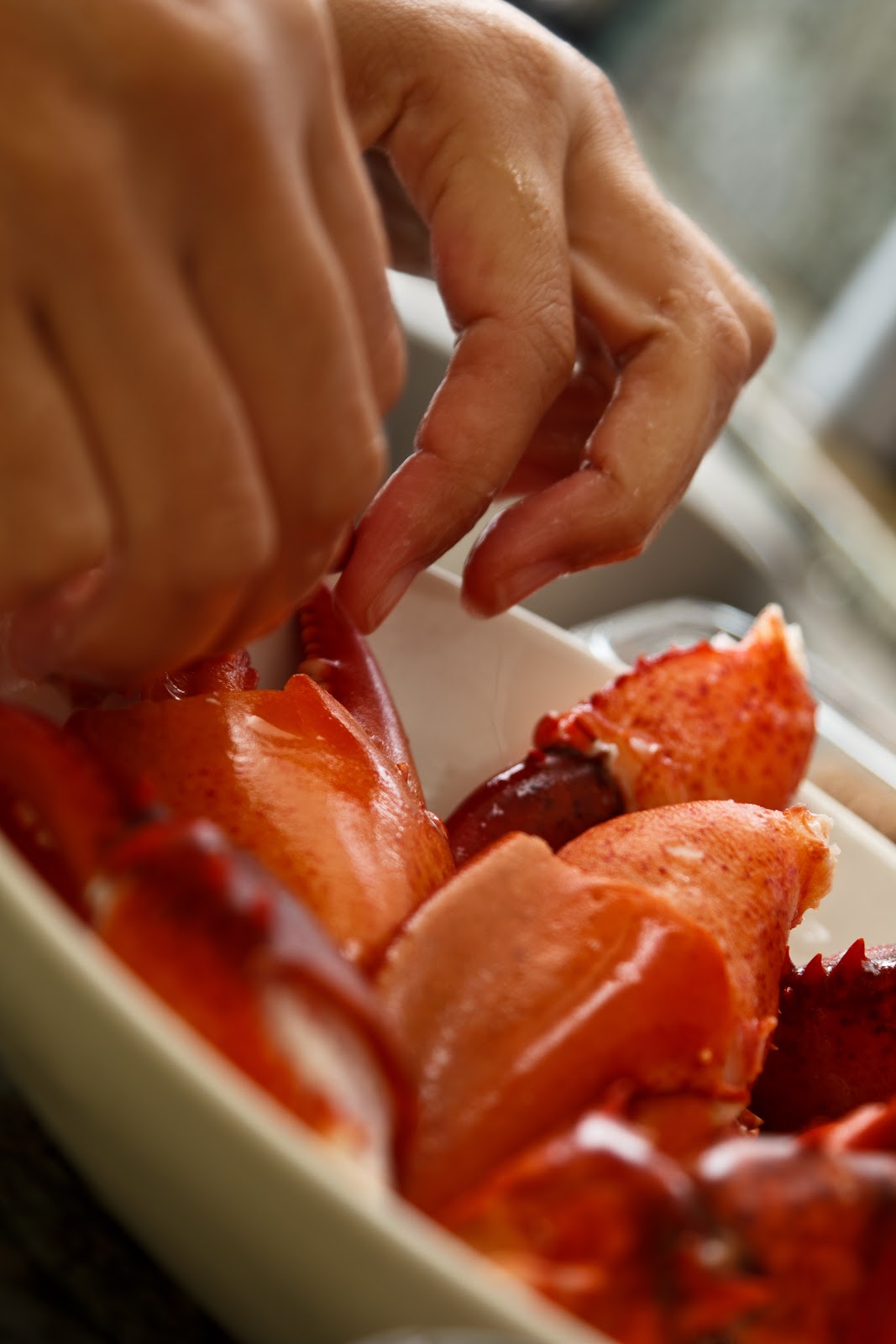
*purchased at Costco.  Comes pre-packaged in 2 lb. bags.  As you might have noticed in the 2nd picture, lobster pieces come scored, simplifying the shelling process.  Most claws just have 1 piece of cartilage in them.

Saturday, July 2, 2011

Okazuya Food: Teriyaki Fish

Ever since I did the corned beef hash post last week, I've spent time reminiscing about the okazuya's I have frequented in Hilo and Honolulu.  If I had my way, I'd eat okazuya food for lunch everyday.  Because of the variety of foods, lunches could be different everyday.

Over 20 years and several boyfriends ago, I lived in Makiki (Honolulu) and enjoyed a carefree life, eating what I wanted, when I wanted.  On weekends, we enjoyed picking up okazu from a place called Kaneda's.  Kaneda's was located on School Street in Liliha.  For those of you familiar with Honolulu, chances are good that you know Kaneda's.  In addition to being an okazu-ya, they also did party catering.  They may even have been able to accommodate small functions on-site, but I don't know for sure.  All I know about Kaneda's is they sold something that really reminded me of home:  teriyaki fish.

My parents often received fish from friends and family.  Dad had friends who went fishing.  Mom's brother had lots of friends who went fishing.  Sometimes it would be fish with head and tail (reef fish like menpachi, kole, aweoweo) and other times it would be a fillet of a big fish (aku, ahi, ono).  I like most reef fish (yes, even with all the bones), but the big fish never appealed to me.  I won't touch aku (skipjack tuna) in any form, and I'll eat ono (wahoo) only if I have to.  There are only two ways I enjoy cooked ahi (yellowfin tuna):  broiled (must be the belly portion) and teriyaki.

Teriyaki ahi is "da bomb".  Because most of the ahi was given to us, we ended up with all kinds of odd-shaped pieces, hardly worthy of sashimi.  Mom would often make teriyaki fish with the odd pieces.  I thought that was something only our family made, as nobody else seemed to eat ahi like that.  Until I discovered Kaneda's.  Same teriyaki taste, same look of the finished product.  Yummmm.

Kaneda's closed sometime in the 90's.  I can't remember what kind of business took over their location, but I'm sure they don't make teriyaki fish.  But no worries . . . teriyaki fish is very easy to make.  The only forethought it requires is the overnight marinating.

Marinating the fish in a plastic bag (yes, Terri, this is a no-no) with the air sucked out gets the marinade evenly into all the odd shaped pieces of fish.
After marinating, the color of the fish will change to a dark maroon.  Drain marinade and pat fish pieces dry prior to dusting with flour.  Be careful not to burn the fish when frying.
Teriyaki fish (or any type of teriyaki) goes amazingly well with ranch dressing salads.
click on recipe title for printable recipe
     ahi, sliced 3/8" thick
     shoyu (same amount as sugar)
     sugar (same amount as shoyu)
     ginger, grated
     flour
     cooking oil

Make a simple marinade using equal parts of shoyu and sugar.  Add ginger.  Add fish.  Marinate overnight in refrigerator.  When ready to cook, drain marinade and dry fish slices with paper towel.  Dust fish in flour and pan fry in shallow oil until golden brown.  Watch carefully, as it can burn quickly.  Drain on paper towel layers.


Thursday, June 30, 2011

Spicy Shredded Potatoes

Those of you who grew up in Hilo have likely experienced this:  you are driving along Komohana Street, somewhere between the 4-Way Stop and Komohana Gardens and you are suddenly hit by the unmistakeable aroma of what can likely be attributed to gobo kimpira (sauteed burdock root).  Sometimes I catch a whiff of it on Kinoole Street in the area between the old Food Fair and Hokama's Chevron.  Yes, I'm showing my age now.  In all my years of living here, I have not been able to pinpoint which house it is that is always cooking this, but maybe someone out there might have the answer.

 Gobo kimpira is one of those Japanese side-dishes that compels you to eat multiple bowls of rice.  I didn't know such a dish existed until I was in the 4th grade and a classmate brought some for a recess snack (yeah, I know, kinda out there as a kiddie snack).  The balance of sweet-salty-spicy was perfect in every thread.  Mmmmmm.  But this post is not about gobo!

Prior to that defining moment, my only experience with gobo was watching my grandma whittle shavings off the tip with a small paring knife.  I have no idea what she did with the gobo shavings, but I certainly don't remember kimpira.

Part of the "charisma" of kimpira is the way the gobo is shredded.  Too thick, and the maker appears clumsy and lacking knife skills.  Too short appears as thought the maker didn't take enough time to cut the gobo correctly.  While I am quick to criticize, I have never made gobo kimpira.  I'll leave that to the okazu-ya pros and Japanese grandmas out there.  But this post is not about gobo!

Somehow, I have not been able to bring myself to buy gobo.  I wouldn't know how to select pieces, and I often wonder who first ate gobo.  Those roots are mighty long and thin. Was there really nothing ABOVE ground to eat?

There are times now, when I drive on Komohana Street and get hit with the gobo kimpira smell.  Often, its inconvenient to go to an okazu-ya at that very moment to get a scoop of it.  I remembered seeing a recipe for kimpira made with potatoes instead of gobo.  I called Mom to ask her if she knew which cookbook to look in. . .I own close to 300 cookbooks so I needed some help.  Unfortunately, she said she never heard of such a thing.  I guess she really didn't take me seriously because she added, "kimpira is made with gobo, not potato!". No help there.

Since I was determined to find the recipe, I began looking through the likely suspects.  Thirteen was the lucky number . . . found it in the thirteenth book I pulled, some Japanese church cookbook.  I made a few changes to the recipe ingredients because I wanted the kimpira to have a stronger taste.  What I like is that the cooking can be controlled to keep the potato crunchy.  What I especially like is that I don't need to run down to KTA to buy gobo!


I shared some of the potato with Aunty Betty (of corned beef hash fame), and she loved it.  She did issue a caveat, and that was to not use the word "kimpira", as it sets up an expectation of taste.  She was right.  The potato was actually very similar to the shredded potato in the Bi Bim Bap served at Sato's Lunch Shop (Hilo, circa 1990s).

So here are some tips for making spicy shredded potatoes.
1.  Use the julienne disc of a food processor, if available.  An alternative to this might be a Japanese crank shredded.  This magical tool is used to make those wonderful curly potatoes for your copycat version of Pietro's raw potato salad.
2.  Do not omit the step of soaking the potato shreds in ice water.  This step removes the surface starch.  If left on, you will end up with a gluey mess instead of discrete strands.
3.  Use a salad spinner to partially dry the potato shreds before patting dry with a paper towel.  You'll save on the amount of paper towels you use.

Monday, June 27, 2011

Okazuya Food

I'm really not sure what I was doing.  I SWEAR I hit the "publish post" button, but I guess I didn't.  I must've lapsed a lot because I found several of these "drafts" just hanging in limbo.  So without further ado, here is where my head was in July 2010. . .

Lately I've been really ono for okazuya food.  On my recent trip to Honolulu, I passed by Fukuya and wondered if they still make that awesome fried hash.  Fried hash and chow funn from Fukuya were treasured parts of my weekend fare when I lived on Oahu.  Unless you've actually had fried hash from Fukuya, you might have a difficult time grasping what it is.

Fried hash is NOT a corned beef hash patty like the kind offered at most okazuyas.  In fact, I can't definitively say there is actually potato in Fukuya's fried hash.  Same goes for corned beef.  What I can say is that fried hash is your typical "patty" shape.  Its roughly a 2" diameter disc thats about 1/2" tall and pan fried just a shade past golden brown.  Its almost like a sweet potato mochi patty I had at some meeting, but I cannot say with conviction that it contains mochiko either.  Sad.  If anyone out there knows how to make Fukuya's fried hash, please let me in on the recipe.  I promise I won't open up an quasi-Fukuya here in Hilo.

So far, this blog has been filled with many doubtful thoughts, so I'm going to go the other way and tell you what I do know.  I know that my Aunty Betty makes THE BEST corned beef hash.  Aunty Betty lives in Mt. View, and on occasion, when work took me to Ka'u, I would stop at Aunty Betty's on the way home and have lunch with her.  Aunty Betty would ask me what I wanted to eat, and I would always request her corned beef hash.  No okazuya can touch her hash.

What separates Aunty Betty's hash from others is the way she prepares the potatoes.  Most people boil potatoes and mash them.  Then they add in other ingredients.  This is how Mom does her, and I will admit here that for most of my life, Mom's corned beef hash was great . . . until I had Aunty Betty's.  Aunty Betty doesn't cook her potatoes before adding in the other ingredients; she grates raw potatoes and then combines the raw potato shreds with corned beef (canned, of course), egg, parsley, salt and pepper.  Then she plops them in an oiled pan, flattens the plops and cooks them until golden brown.  Same thing with the other side.  The result is a slightly scraggly patty with potato shreds which still have body.  Mmmmmm.

Unlike my previous posts, this post doesn't have a recipe after the jump.  I've just included pictures of Aunty Betty's Hash.  Well, not exactly Aunty Betty's Hash.  I made the hash, using Aunty Betty's method.  I've been eating her hash for nearly a decade, and no matter how I try, her hash still comes out better. 


But for those of you who still do the double-cooked potato method, here is a trick Mom taught me for getting those patties really nice.  After you flatten them into patty shapes, dust them lightly with flour before frying.  The flour will hold the patties together.  Trust me, the patties look really nice, but still, when it comes to great hash, scraggly looking or not, NOBODY can touch Aunty Betty's hash.